Sleep & Stress · A personal journey · 18 min read
You're Not Broken.
You've Just Been Running on Stress Too Long.
Here's how CBD, daylight, and a few small shifts can help you exhale.
Theresa Strahan, BSN, RN, CNHC · Registered Nurse & Cannabis Health Coach
October 12, 2026 · Educational information only. Not medical advice; does not replace your prescriber or pharmacist.
Quick Answers
- Your body has a built-in stress brake, the endocannabinoid system (ECS). Research, mostly in animals, suggests prolonged stress can weaken parts of that brake; it does not diagnose why any one person feels wound up.
- Chronic stress is not just "a bad week." It is long stretches with no recovery, like caregiving, money worry, or a job that never switches off. Research in midlife women links each of those to measurable wear and tear on the body.
- CBD may help your own anandamide last a little longer, but "rebuilding" the system is an idea, not a proven result.
- CBD may help some people feel calmer, but the research is mixed. Some small trials found less anxiety. Many found nothing. Almost none were designed around women.
- A low dose of THC (7.5 mg) calmed stress in one small trial, but a higher dose backfired, and CBD softened THC's anxiety in another analysis. No study has tested whether CBD with a trace of THC, as in hemp products, creates a lasting shift. My own experience of it is just that: mine.
- Daylight, a walk outside, slow breathing, and gentle movement each have their own research on stress and mood. No study has tested them together with CBD, so I will not tell you they multiply each other. I will tell you why stacking them is reasonable.
- Small shifts add up. Track a comfortable new routine for up to 30 days; do not wait if symptoms worsen.
Why Do So Many of Us Feel Like a Caged Animal?
You know the feeling. The body is going, the mind is going, and nothing in you gets to settle. You are ready for the next thing before this one is done.
It is not weakness, and it is not in your head. It is stress biology doing what it was built to do, just for far too long. Anxiety disorders are diagnosed at nearly double the rate in females, according to researchers writing in Cannabis and Cannabinoid Research. Women are often carrying work, family, and everyone else's moods at the same time, with very little recovery in between.
Good question: Why do I feel so wound up all the time? Chronic stress keeps your stress response switched on, and research suggests prolonged stress lowers your own endocannabinoid signaling, which weakens a natural brake on that response. If the feeling is constant or affecting your life, talk to your provider.
What Does the Endocannabinoid System Have to Do With Stress?
Think of the ECS as part of your body's built-in brake pedal for stress. Its two main molecules, anandamide and 2-AG, were discovered by Professor Raphael Mechoulam's team at the Hebrew University of Jerusalem in 1992 and 1995, and the university's cannabinoid research center lists stress management as one of its focus areas.
Researchers reviewing the field in Neuropsychopharmacology (Hill and colleagues, 2016) describe a pattern seen across many studies, mostly in animals: stress lowers anandamide, one of your body's own cannabis-like molecules, and a drop in anandamide is linked to switching the stress response on and to more anxiety-like behavior. Another molecule, 2-AG, rises and helps shut the response back off. They also report that chronic stress reduces CB1 receptors in almost every brain region studied, which weakens the brake.
That connects to Dr. Ethan Russo's idea of Clinical Endocannabinoid Deficiency: some people may simply run low on endocannabinoid tone. In his 2016 review he cites imaging evidence of ECS problems in PTSD along with the migraine, fibromyalgia, and IBS evidence. It is a theory with supporting findings, not a settled diagnosis. Realm of Caring, which follows this research closely, says the same: it calls ECS deficiency a hypothesis, "not yet a settled clinical framework." It is also a gentle way to ask the question: what if I'm not failing at coping, but running low on a system that helps me settle?
For women, there may be another layer. Research on the female reproductive system suggests the ovaries make anandamide in step with estrogen, so shifts in estrogen across the cycle and into perimenopause may change how well this brake works. That is an area where I want to see more human data before saying anything stronger.
What Happens When Stress Never Switches Off?
Stress itself is not the enemy. A short burst of stress is how your body rises to a deadline, a scare, or an emergency. Researchers who study this describe the ECS as part of what keeps that burst in check: a review of stress and endocannabinoid-CB1 signaling reports that acute stress activates that signaling, which buffers the behavioral and hormonal effects of the stress.
The trouble starts when the stress doesn't end. The same review reports that chronic variable stress reduces endocannabinoid-CB1 receptor signaling, and the authors hypothesize that this shortfall contributes to the harm chronic stress does. Hill and colleagues (2016) add that chronic stress reduces CB1 receptors in almost every brain region examined. Most of this work is in animals, and the human findings point the same way but are less complete.
Put plainly: a brake you lean on constantly can wear thin. It's not that you failed at stress. It may be that your system has been working overtime with no chance to recover.
A common question: do we end up with too many receptors? In the brain's stress circuits, the research I've reviewed points the other way: stress lowers CB1 receptors. There's a separate finding in immune cells. In lab experiments on human blood cells, inflammatory signals (IL-1β, IL-6, and TNF-α) turned up CB1 and CB2 receptor numbers. Whether that is the body trying to calm inflammation or something that feeds it is not yet clear, so I wouldn't say receptors "flood in and make inflammation worse." What we can say is that inflammation and the ECS are in conversation.
Good question: Can chronic stress damage my endocannabinoid system? Research, mostly in animals, suggests chronic stress reduces endocannabinoid-CB1 signaling and CB1 receptors in many brain regions. The human evidence points the same way but is less complete. "Damage" is stronger than the research supports. "Worn down" is closer.
Inflammation is part of the picture. Researchers have proposed that under prolonged stress, immune cells can become less responsive to cortisol's "off switch," so inflammation can run unchecked (Cohen and colleagues, PNAS, 2012). In midlife women, a study measuring "allostatic load," a score of wear and tear that includes stress hormones, blood pressure, metabolic markers, and inflammation markers such as CRP, IL-6, and TNF-α, found links to stress. More on that next.
What Counts as Chronic Stress?
Many women don't think of their lives as "stressful," because it's just life. Chronic stress is not only a crisis. It is sustained demand without enough recovery. Here are the kinds researchers have measured:
- Caregiving. Raising kids, caring for an aging parent, a sick spouse, or a family member who needs you every day.
- Money strain. Debt, unpredictable income, or the constant math of making it work.
- Work strain. A job that follows you home, or a business you carry in your head.
- Health worries, yours or someone else's.
- Family and relationship strain, including a family member's substance problems.
- Housing instability.
These examples draw on a 2011 study in Annals of Behavioral Medicine of 301 healthy, middle-aged Mexican-American women. Work stress, financial strain, and caregiving stress were each independently linked to higher allostatic load, and severe financial strain was linked to about one point higher on the 12-point scale. The authors note important limits: it was a single snapshot in time, so it can't prove the stress caused the wear and tear, each stressor was measured with one question, and the findings may not apply to every group of women.
How do you know if it's chronic? Ask yourself some functional questions, not a score:
- Do I feel tired but wired?
- Do I feel braced, even on days off?
- Can I sit for ten minutes without reaching for something to do?
- Has it been months, or years, since I felt properly rested?
If several of those are a yes, you are not weak. You may be carrying a load with no off-ramp. Talk to your provider, especially if you also have trouble sleeping, persistent low mood, or panic.
Can CBD Help "Rebuild" a Worn-Down System?
This is where I want to be most careful, because it is the question that matters most.
What we can say:
- In lab work, CBD slows FAAH, the enzyme that breaks down anandamide, in rat brain tissue. In theory, that leaves more of your own anandamide around.
- In a small 2012 trial in Translational Psychiatry (Leweke and colleagues), 42 people hospitalized with schizophrenia were treated with CBD or an antipsychotic. Blood anandamide rose more with CBD, and bigger rises went with bigger symptom improvements. The study was exploratory, ended early, and the authors say it can't show cause and effect.
- In a 2023 trial in 70 adults trying to quit cannabis, 800 mg a day of CBD for 28 days kept blood anandamide from falling the way it did on placebo. A lower 400 mg dose showed no effect, and the changes in anandamide were not linked to changes in anxiety or depression. The authors call it preliminary.
What we can't say:
- That CBD rebuilds your receptors or repairs an ECS worn down by stress. No study I found shows that.
- That any of this applies to stressed women, or to the doses most people actually take. These studies were in other groups, at much higher doses.
What I'd say to you as a nurse: CBD may help your own anandamide last a little longer, which is a plausible and early idea, and it may be one reason some women feel more settled. Exercise raises anandamide too, which is part of why pairing the two makes sense. But CBD isn't a substitute for rest, support, or fixing whatever is draining you. It's one tool that may help you get to a place where recovery is possible.
Good question: Can CBD rebuild my endocannabinoid system? That has not been shown. CBD slows an enzyme that breaks down anandamide, and two small human trials saw anandamide effects, but neither studied stressed women, and the doses were high. Treat "rebuild" as an idea, not a result.
When Was the Last Time You Felt Truly Relaxed?
Strong women get things done. So let me ask you something, and be honest with yourself.
How often do you brush off being busy and laugh about it? "Oh, I'm fine. Just busy." And somewhere along the way you decided that how you feel is normal.
But how would you know what normal feels like if you've never felt true, deep relaxation?
If you've ever had a massage, you know the moment. Somewhere around the halfway point, maybe further in, your shoulders drop. You take a deep breath, and then comes the exhale, the long one you didn't know you'd been holding. That is what a body does when it finally gets to let go.
That is not a luxury. It's what the human body needs on a regular basis. Not every day, all the time. But our bodies yearn for it, and we need it to recover. Wanting it isn't weakness. It's biology.
I felt a version of that shift myself when I started using CBD: I could feel myself calming and settling, and I no longer felt so much like a caged animal. That was one woman's experience, and it doesn't mean the same will happen for you. But it taught me what I'd been missing.
What Does the Research Say About Rest and Recovery?
The honest answer is that the science of deep rest is still young, and "cellular recovery" is where it is youngest. Here is what I can responsibly say:
- Relaxation changes more than your mood. In a 2013 study in PLOS ONE, researchers drew blood before and after a 20-minute "relaxation response" session of diaphragmatic breathing, a body scan, a mantra, and mindfulness. In 26 long-term practitioners, activity in pathways tied to energy metabolism and insulin went up, and activity in inflammation pathways (including NF-κB) went down. Novices who completed eight weeks of training showed some similar patterns. It was small, not randomized, and the authors call it preliminary. A 2017 correction added disclosures about the authors' financial and institutional interests; it did not revise the study findings.
- Wear and tear can show up in your cells. In Elissa Epel and Elizabeth Blackburn's 2004 study of mothers caring for a chronically ill child, the caregivers as a group did not differ from comparison mothers in telomere length (a marker of cellular aging). But within the caregiver group, more years of caregiving went with shorter telomeres and lower telomerase, and mothers who didn't see themselves as severely stressed showed less shortening. Later work has linked chronic stress, caregiving, and disadvantage to shorter telomeres, and one study of meditators found higher telomerase than controls. These are associations, not proof, and telomeres are a debated marker.
- What this adds up to: your body appears to respond to stress and to rest at the cellular level. That fits with the idea that recovery is part of health. It does not mean one massage or one deep breath repairs your cells.
If slowing down makes you feel uneasy at first, that is common, and it's worth mentioning to your provider, especially if it brings on panic or real distress.
What Does the Research Say About CBD and Calm?
Here is the honest version, which I think is the most useful one.
Where it looked promising. In a randomized, double-blind study in Neuropsychopharmacology (Bergamaschi and colleagues, 2011), 24 people with untreated social anxiety took either 600 mg of CBD or a placebo before a public-speaking test. The CBD group reported significantly less anxiety, less discomfort, and less trouble thinking clearly during the speech, and looked more like the healthy comparison group. The authors called it preliminary. It was small (12 people per group) and a single dose.
Where it didn't. A 2024 systematic review in Life looked at 15 randomized trials of CBD for anxiety, about 673 people in all. Nine of the 15 found no benefit from a single dose. Two reported that 600 mg increased anxiety. Benefits showed up at 300 mg in public-speaking tests and with 300 mg taken daily for two weeks. The authors called the results conflicting, and only one trial studied people diagnosed with generalized anxiety.
The dose gap. Those trials used 300 to 600 mg in a single dose. A 2026 study of 149 active women aged 18 to 40 found that 62.5% of CBD users took 25 mg a day or less. That is a very different amount, and this is not a reason to chase trial doses on your own.
The women gap. The authors of a review in Cannabis and Cannabinoid Research state that no clinical trial has looked at sex differences in CBD's anxiety-reducing effects, and the animal studies were all in males. The one women-only randomized trial I found, a 2024 JAMA Network Open study of 50 women with advanced breast cancer and anxiety, gave 400 mg of CBD before a scan. Its main goal was not met, though some secondary measures, such as feeling "afraid," were lower with CBD. Even in a field this young, that tells us something: women's stress and CBD is wide open, and most of what you read online is extrapolated from men and animals. Meanwhile, cannabis industry reporting in MJBizDaily (March 2025) says women are driving the wellness side of the market, with stress relief, sleep, and pain as the main reasons. Those figures come from companies, not independent research, so I'd treat them as a signal of who is buying, not proof of what works.
So what can I say? CBD may help some people feel calmer. It is not a proven treatment for anxiety, and a good result for one woman does not guarantee another.
Good question: How much CBD should I take for stress? There is no established dose. Trials used 300 to 600 mg in single doses, while many women use 25 mg a day or less. Start low, go slow, keep a log, and talk to your provider before increasing it.
And will it get me high? Pure CBD doesn't cause a high, but hemp-derived products can contain trace THC. Check the lab report on your product.
What Happens When Your Brain Finally Starts to Calm Down?
Here is something I didn't expect. I started using a hemp-derived CBD product with only a trace of THC, well under the 0.3% limit my state allows, to treat my pain and inflammation. What I discovered was that the healing went much, much deeper than that.
As my brain began to calm down, I became acutely aware of myself, and of things in my life I had been too wound up to notice. The pain eased, yes. But so did the constant static. It felt like the volume on everything had been turned down just enough for me to hear what was underneath.
That is my experience, and I'm telling you what it was, not promising it will be yours. Here is what the research can and can't say about it.
What the science supports. In a small randomized, double-blind study (Childs and colleagues, 2017), 42 healthy adults took placebo, 7.5 mg of THC, or 12.5 mg of THC before a stressful mock job interview. The 7.5 mg group reported less distress afterward, saw the task as less threatening, and recovered faster. The 12.5 mg group felt worse: more negative mood and a poorer performance. Another randomized trial from Wayne State University, in 71 people with and without trauma histories, found that a low dose of THC reduced the amygdala's reaction to threat on brain imaging. The amygdala is the part of your brain that sounds the alarm. And in a review of human studies (Lichenstein, 2022), adding CBD blunted the rise in anxiety that came with a higher THC dose in one pooled analysis of 40 people.
A note on dose. The 0.3% figure is a limit on the product (THC as a share of dry weight), not a dose or a guarantee of legality in your location. How many milligrams of THC you actually take depends on the product and how much you use, so check the lab report and serving size. A hemp product can still deliver an impairing amount of THC. These studies do not establish what a particular CBD product with trace THC will do.
What the science can't say yet. I could not find a study that tested CBD plus very low-dose THC for a lasting shift in how calm or self-aware someone feels. Both of the lab studies above gave a single dose to healthy adults, were small, and were short-term. The Wayne State follow-up study in people with PTSD gave mixed results, with some brain areas more active on THC. These short-term findings are not proof that THC treats an anxiety disorder or produces lasting calm. Higher doses produced more anxiety. In one pooled analysis women showed larger increases, and in a trial of 37 women, 15 mg raised anxiety while 7.5 mg did not.
What I think it means. When your nervous system has been on high alert for years, the noise can drown out everything else: your body's signals, your feelings, even what you want. If something quiets that alarm, whether it's CBD, rest, movement, or all of it together, you may start noticing what was there all along. That idea is consistent with the stress research above. It has not been tested for CBD with a trace of THC, and I would not want you to read it as a promise.
Good question: Is more THC better for calming down? No. In the research, the lower dose helped and the higher dose backfired, and women in some studies were more sensitive. If a product contains THC at all, start very low, go slowly, and don't drive or work after a dose until you know how it affects you.
Is it okay to try this on my own? Please talk with a pharmacist or provider first, especially if you take an SSRI or an anti-anxiety medication, have a history of anxiety, panic, or psychosis, are pregnant or nursing, or are drug tested at work. THC products are not legal everywhere, so check your state's rules.
Why Would CBD Pair Well With Daylight, a Walk, or Stretching?
Let me be careful here. No study has tested CBD plus sunlight plus a walk. What we have is research on each piece, and the pieces touch the same stress systems.
A short time outdoors. In a 2019 study in Frontiers in Psychology (Hunter and colleagues), people spent time in nature of their own choosing, 10 minutes or more, at least three times a week for eight weeks, with no phone or social media. Stress-hormone (cortisol) levels dropped most efficiently after about 20 to 30 minutes of sitting or walking. (The study as reported didn't describe a control group, so treat it as a promising signal.) A meta-analysis of forest-bathing studies (Antonelli and colleagues, 2019) found lower cortisol in forest groups, with the authors cautioning that placebo effects may play a role and the data are limited.
Moving your body. Cannakeys lists regular exercise among the practical ways to support your endocannabinoid tone. A review in The Neuroscientist found that 14 of 17 studies in humans showed higher anandamide after a single bout of exercise, and about 80% of those studies reported reduced anxiety. It also cautions that reliable proof that endocannabinoids cause the "runner's high" in people has not been achieved. Intensity matters: one study found anandamide rose at moderate-to-vigorous effort, not with easy walking, while a later study found increases after both walking and running, about twice as much after running. In plain English, a brisk walk where you are a little out of breath has a better case than a stroll, and an easy walk is still worth it for the time outdoors.
Slow breathing. A small 2025 study in Scientific Reports had 25 young women follow audio-guided slow breathing versus a faster rhythm. They rated negative images as less upsetting and less arousing with the slower rate. It was very small and short (30-second blocks), so I'd call it an early signal, not evidence that one exact breathing rhythm is best for everyone.
Yoga. It has its own research on anxiety, including a 2018 meta-analysis of randomized trials (Cramer and colleagues).
Daylight. Light helps set your body's clock, which is tied to sleep and stress. The time-outdoors studies above are the best evidence I've reviewed on this.
So here's the honest version of your experience: CBD may help take the edge off, and the walk, the light, and the breathing each give your stress systems something to work with. Stacking them is reasonable. Calling it a proven formula is not.
Good question: Is a walk really as good as exercise for stress? For stress, the time outdoors matters: a 2019 study found cortisol dropped most efficiently after 20 to 30 minutes in nature. For the endocannabinoid effect, studies suggest moderate-to-vigorous effort raises anandamide more reliably than a slow stroll.
And do CBD, sunlight, and a walk work better together? No study has tested that combination, so I can't promise it. Each piece has its own evidence, and stacking them is reasonable.
What Do Small Shifts Look Like in a Real Day?
Not tiny steps. Small shifts, ones you can keep. Pick one or two.
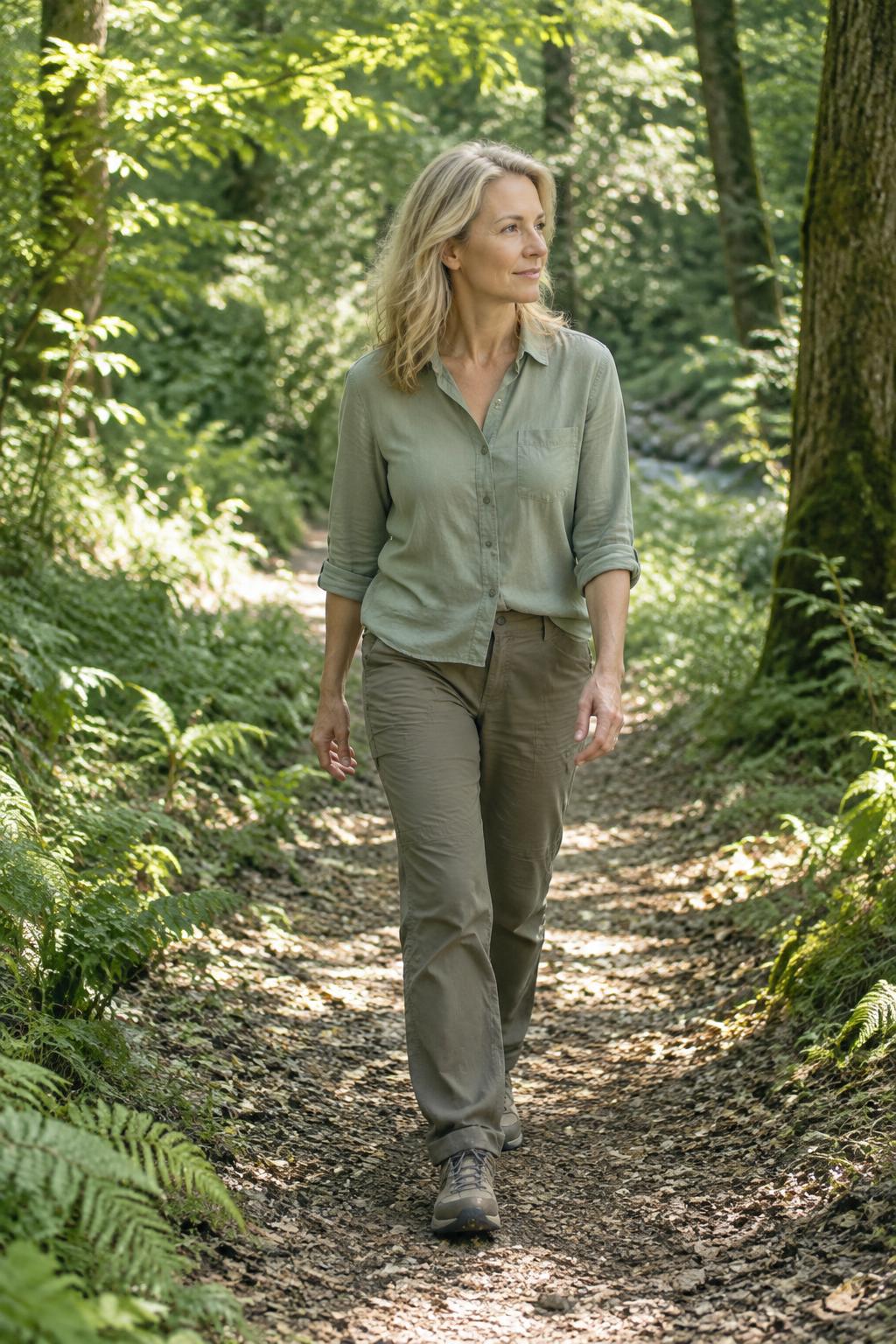
- Take your morning outside. I make sure I get outside in the sunshine every day, whether I'm walking or biking, and I give myself something beautiful to look at. On weekends I leave my phone behind and go hiking. Your version doesn't have to be that big. Even 10 minutes with your coffee, no phone, in daylight.
- Make one walk a "nature pill." Aim for 20 to 30 minutes outdoors when you can. Walk briskly enough to feel your breathing pick up if that's comfortable for you.
- Add five minutes of stretching or yoga before bed or when the day starts to tighten you up.
- Breathe slower than you want to. Try a gentle 6 seconds in, 6 seconds out for a few minutes if comfortable. Do not force deep breaths or hold your breath; stop if you feel dizzy or distressed.
- If you use CBD, keep a simple log. Product, dose, time, and how calm you felt on a 1-to-10 scale. Change one thing at a time. Cannabis nurse educators, including the team at Holistic Caring, stress that this is individual: the right product, ratio, dose, and timing is something you work out step by step, as an active partner in your own care.
Who Should Talk to a Pharmacist or Provider First?
CBD is not risk-free, and "natural" does not mean "safe with everything."
- Blood thinners: warfarin (Coumadin), Eliquis (apixaban), Xarelto (rivaroxaban). CBD can interact with some of these.
- Sedatives and anti-anxiety medicines: alprazolam (Xanax), clonazepam (Klonopin), gabapentin. Added drowsiness is possible.
- Antidepressants, including SSRIs: ask your pharmacist how CBD may interact with your specific medication.
- Liver conditions: talk to your provider first. Pregnancy and breastfeeding: avoid CBD and THC; discuss safer options with your care team.
- Drug testing: hemp-derived CBD products can contain trace THC, and in real clinical trials full-spectrum products have caused positive tests. If you are tested at work, I wrote about this in "Could This Happen to You?".
Don't Give Up: A 30-Day Check-In
For comfortable lifestyle changes, use 30 days as a check-in, not a medical rule or a promise of results. Track a little. Change one thing at a time. Do not wait 30 days to ask for help if symptoms worsen or a product causes unwanted effects. If you are not better at your check-in, that is useful information to bring to your provider, not proof that nothing can help you.
Free printable: the Small Shifts Reset Sheet. A two-page companion to this article with the "tired but wired" check-in, the five small shifts as a checklist, a safety reminder, and a 30-Day Calm Log so you can see what's changing. Download the free Small Shifts Reset Sheet. No purchase required.
Sources
- Hill MN et al. Neurobiological Interactions Between Stress and the Endocannabinoid System. Neuropsychopharmacology 2016. Abstract (abstract only; full text behind login)
- Russo EB. Clinical Endocannabinoid Deficiency Reconsidered. Cannabis Cannabinoid Res 2016. PubMed
- Bhasin MK et al. Relaxation Response Induces Temporal Transcriptome Changes in Energy Metabolism, Insulin Secretion and Inflammatory Pathways. PLOS ONE 2013. PLOS ONE (2017 correction: competing interests)
- Epel ES, Blackburn EH et al. Accelerated telomere shortening in response to life stress. PNAS 2004. Described in APS Observer, "The Long and the Short of It" (I read the summary, not the original paper)
- Gallo LC et al. Domains of Chronic Stress, Lifestyle Factors, and Allostatic Load in Middle-Aged Mexican-American Women. Ann Behav Med 2011. OUP
- Cohen S et al. Chronic stress, glucocorticoid receptor resistance, inflammation, and disease risk. PNAS 2012. PNAS (title and summary only; I could not open the full paper)
- Stress regulates endocannabinoid-CB1 receptor signaling (review). PubMed (abstract)
- Effects of pro-inflammatory cytokines on cannabinoid CB1 and CB2 receptors in immune cells. PMC (human blood cells, lab)
- Leweke FM et al. Cannabidiol enhances anandamide signaling and alleviates psychotic symptoms of schizophrenia. Transl Psychiatry 2012. Nature
- Effects of cannabidiol on anandamide levels in individuals with cannabis use disorder. Transl Psychiatry 2023. Nature
- Bergamaschi MM et al. Cannabidiol reduces the anxiety induced by simulated public speaking in treatment-naïve social phobia patients. Neuropsychopharmacology 2011. Nature (abstract)
- The Impact of Cannabidiol Treatment on Anxiety Disorders: A Systematic Review of RCTs. Life 2024. MDPI
- Childs E, Lutz JA, de Wit H. Dose-related effects of delta-9-THC on emotional responses to acute psychosocial stress. Drug Alcohol Depend 2017. Described in Neuroscience News (press coverage; the abstract page was blocked, so I did not quote physiology results)
- Lichenstein SD. Human Studies of THC and CBD and Anxiety: A Narrative Review. Current Addiction Reports 2022. PMC (includes Sholler 2021, Pabon 2022, and Arkell 2022 as cited there; I did not read those originals)
- Wayne State University, low-dose THC and amygdala reactivity to threat (n=71): Wayne State (news page; dose not stated)
- Zabik NL et al. Cannabinoid modulation of corticolimbic activation during extinction learning and fear renewal in adults with PTSD. Neurobiol Learn Mem 2023. Summary (abstract summary only)
- Wright M, Di Ciano P, Brands B. Use of Cannabidiol for the Treatment of Anxiety: A Short Synthesis of Pre-Clinical and Clinical Evidence. Cannabis Cannabinoid Res. Summarized by PsyPost
- Nayak MM et al. Cannabidiol for Scan-Related Anxiety in Women With Advanced Breast Cancer. JAMA Netw Open 2024. JAMA
- Pojednic R et al. CBD use in recreationally active women. Frontiers in Nutrition 2026. Summarized by mindbodygreen (observational; I did not read the primary paper)
- Hunter MR et al. Urban Nature Experiences Reduce Stress in the Context of Daily Life. Frontiers in Psychology 2019. ScienceDaily summary
- Antonelli M, Barbieri G, Donelli D. Effects of forest bathing (shinrin-yoku) on levels of cortisol as a stress biomarker. Int J Biometeorol 2019. Springer
- Do Endocannabinoids Cause the Runner's High? Evidence and Open Questions. The Neuroscientist. SAGE
- Luo et al. The effect of slow breathing in regulating anxiety. Sci Rep 2025. Nature
- Cramer H et al. Yoga for anxiety: a systematic review and meta-analysis of RCTs. Depress Anxiety 2018. Wiley (not yet read; no figures quoted)
- Hebrew University Cannabinoids Research center (Mechoulam's work on anandamide and 2-AG; stress management as a research focus): cannabinoids.huji.ac.il
- Jackson M. Women are driving the wellness revolution in cannabis. MJBizDaily, March 5, 2025. MJBizDaily (industry reporting; figures come from companies)
- Holistic Caring, Cannabis Nursing is a Specialty (principles reframed in my own words): holisticcaring.com
- Cannakeys, Endocannabinoid Tone: cannakeys.com
- Realm of Caring (framing only; advocacy source): Cortisol vs. Endocannabinoids
Keep exploring calm, stress & your ECS
- This One's for the Ladies — How Your Ovaries Make Their Own Cannabis-Like Molecule
- Cannabis for Anxiety: When THC May Calm You — and When It Can Do the Opposite
- How to Wake Up Your Endocannabinoid System — The Good, the Bad, and the Real Deal
- Why Weight Loss Can Feel Impossible: Inflammation, Insulin Resistance, Berberine, and Where CBD May Fit